
Roots in Red Dust
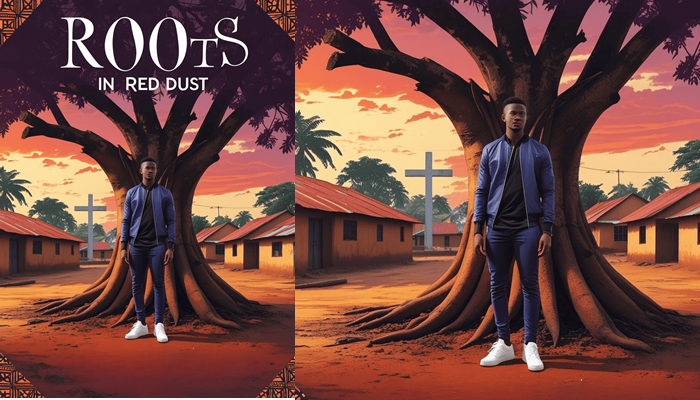
Chapter One: The Last Name I Never Knew The moment Jordan Ayotunde Brown stepped off the plane at Murtala Muhammed International Airport, the Lagos heat hit him like a slap. It wasn’t just hot—it was humid, sticky, like walking into someone’s breath. He pulled off his Ray-Bans, blinking against the brightness. The air smelled of jet fuel, roasted corn, and a chaos he couldn’t name. Welcome to Nigeria. He hadn’t even reached the terminal when two men approached him. “Oga! Welcome o. Do you need taxi? Airport taxi, I go carry you go anywhere!” “I dey here o. Na me first talk to am! Oga, come make we go. Fine boy like you no suppose dey waka anyhow.” Jordan chuckled awkwardly, clutching the handle of his Louis Vuitton suitcase. This was already more attention than he was used to. “Uh, I have a ride,” he mumbled. It was a lie. He was stalling. Truth was, he didn’t know what he was doing—not really. He had arrived in a country he’d never stepped foot in, with only a name, a photograph, and a mother’s broken memories to guide him. Three weeks earlier, back in Atlanta, Georgia, his mother had finally broken. “Your father’s name… was Fisayo,” she had said through tears. “Adebayo Fisayo. From Ibadan. We were in love, but… things fell apart. I left because I had to. I was scared. And I was pregnant.” Jordan had stared at her. “You’ve kept his name from me for twenty-five years. Why now?” Omotola couldn’t meet his eyes. “Because you asked me to invite him to your wedding. And I couldn’t lie anymore.” He had felt something shift inside him that day – an ache that no amount of success could suppress. His fiancée, Janelle, encouraged him. “Go find him,” she had said. “Even if it ends in disappointment, at least you’ll know.” And so, Jordan went. A week into Nigeria, Jordan had made it to Ibadan. He took a room at BON Hotel behind Cocoa Mall. The hotel was clean, quiet, and most importantly, air-conditioned. He spent his first day trying to recover from jetlag and Lagos. Ibadan was less aggressive than Lagos, but it came with its own rhythm – laid-back but loud, sprawling but deeply rooted in history. He had only one photo: a faded Polaroid of a man in his twenties standing next to Omotola, both smiling shyly in front of a Peugeot 504. Fisayo had a strong jawline, a wide nose, and deep-set eyes that reminded Jordan uncomfortably of his own. He scanned it into his phone and showed it to the hotel receptionist. “Excuse me… do you recognize this man? Maybe from back in the day?” The girl leaned in, squinting. She had pink braids and long eyelashes that fluttered like butterfly wings. “Oga, dis one don tay o. This picture na before GSM. Hmmm… him face be like Ibadan boy sha. Maybe Dugbe side. You fit ask for Dugbe.” “Dugbe side? What’s that – like a neighborhood?” She giggled. “Na big market and mechanic place. Plenty old people still dey there. You go fit see person wey sabi am.” Jordan nodded. That was something. He took a cab to Dugbe the next morning, wearing jeans, a white polo shirt, and sneakers that drew too much attention. A hawker tried to sell him fufu through the car window. Two kids chased after the cab, shouting, “Oyibo! Oyibo!” despite his brown skin. Apparently, his accent, cologne, and confusion gave him away. The mechanic shops in Dugbe lined the road like rusting skeletons. Jordan stopped at a stall where three men sat under a faded Coca-Cola umbrella, sipping orijin and arguing about Arsenal. He greeted politely. “Good afternoon sirs. Please, I’m looking for someone. His name is Adebayo Fisayo. He would be in his fifties now. Used to live around here in the ’90s. Maybe worked as a mechanic?” One of them raised an eyebrow. “Fisayo… Fisayo Mechanic? You mean Fisayo wey dey fight anyhow?” “Ah! That one wey im girlfriend run go abroad?” another chimed in. Jordan’s heart jumped. “Yes! Yes, that’s him. Do you know where he is now?” The third man spat. “That one? Nobody don see am since. Dem say e run mad small. Or travel. Nobody sabi. You go fit ask Mama Shade. She sabi everybody for here.” Jordan took down directions. Hope sparked. Mama Shade lived a few streets down in a one-room shack with a sewing machine by the window. She looked like she hadn’t aged a day since 1975. “Come inside, my pikin,” she said, waving him in. “You say you be who? Jordan? From America? Omotola pikin? Chineke! She don born fine boy like you?” He nodded. Tears welled up in her eyes. “Omotola… that girl suffer o. Your papa nearly finish am. But she loved him. Too much. Maybe na why she run. I beg, sit down. Make I tell you wetin I know.” Jordan listened. Every word felt like a stitch pulling his heart tighter. That night, back in the hotel, he stood by the window looking out at the red dust of Ibadan settling on roofs and roadside trees. His journey had just begun, and already, the truth was proving heavier than he had imagined. He whispered into the silence, “I will find you, Fisayo. Even if I have to search every corner of this city. You will walk me down that aisle.” The red dust swirled beneath a full moon. The roots were beginning to stir. Chapter Two: The Chronicles of Dugbe and Dug-Don’t Ibadan had a strange way of making time stretch. The mornings began early with the cries of roosters and the cackling of women at the communal tap. By noon, the heat sat heavy on everything. And by evening, the sky turned a tired grey as if the city itself had given up trying to keep up. Jordan was learning to adjust. He returned to Dugbe the next morning, retracing his