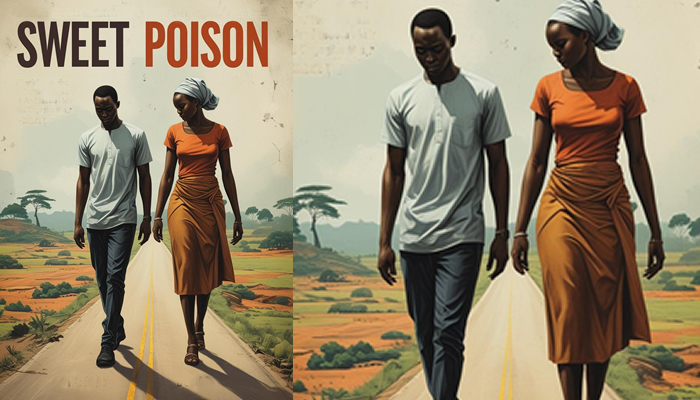
Sweet Poison
Chapter 1 – The Girl at the Food Stall Niyi wasn’t sure if it was the sun or the hunger that was making him dizzy. Lomé was different from Lagos – slower, softer, but just as unpredictable. He had been in the city for only five days, but it already felt like he was walking through a dream he couldn’t fully understand. The red-clay dust coated the soles of his sneakers. The air smelled of spice, salt, and diesel. The people smiled with a politeness that didn’t always reach their eyes. He was standing at a roadside stall just off Rue de la Kozah, eyeing a tray of akara balls. The woman selling them was already wiping her hands on her wrapper, expecting him to pay. But Niyi hesitated, frowning like the akara had personally offended him. That was when he heard her voice behind him. “Why are you looking at the akara like it insulted you?” He turned. She stood with one hand on her hip, her lips curved in a half-smile. Brown skin glowing under the noon sun, braids neatly tucked beneath a colorful scarf, and a calm in her eyes that didn’t match the chaos of the street. “I’m just deciding if I want to commit to it for life,” Niyi said, grinning. She raised an eyebrow. “Commitment issues. I see.” He laughed. Loudly. Too loudly. A few heads turned. She didn’t seem to mind. “Let me guess,” she added, walking closer. “You’re not from around here. Nigerian, maybe? Yoruba?” “Guilty.” “You people and your sharp mouths.” She turned to the akara seller and said something in Ewe, fast and lyrical. The woman chuckled and handed her a small paper wrap of akara, then passed one to Niyi too. “I didn’t pay yet,” he said. “First time is on me,” she replied, popping a piece into her mouth. “Next time, you can buy for both of us.” Niyi blinked. “You assume there’ll be a next time.” “There always is. When the akara is this good.” She walked off, just like that, daring him to follow her. He did. They strolled side by side through the dusty streets, nibbling on hot akara and tossing jokes like old friends. She told him her name was Adjoa – half Nigerian, half Togolese. Her mother was from Ibadan, her father from Kpalimé. She grew up speaking Yoruba, Ewe, and French, but preferred English for the way it let her play with sarcasm. “And you?” she asked, brushing crumbs from her lips. “Why are you in Togo? Business? Pleasure? Or just running from something?” He smirked. “Maybe I’m running to something.” “Or someone?” He gave her a look. “Too early to tell.” She didn’t blush. Instead, she slowed her pace and looked at him with that same calm, almost unreadable expression. “People come to Lomé looking for peace. Or escape. But sometimes, the city gives you what you didn’t know you were looking for.” Niyi chewed in silence. The truth was, he didn’t know why he was in Lomé. Not really. He told people it was for work – a small logistics deal he was trying to broker between two West African firms. But that wasn’t the full story. He was tired of Lagos. Tired of endless traffic, recycled relationships, unspoken pressure. Lomé felt like a pause. A fresh start. And then Adjoa had appeared like a glitch in the script. They walked until the sun softened. She took him past narrow alleys, small shops with handwritten signs, children kicking deflated footballs. Eventually, they sat under a mango tree near her compound. She pointed to the bench like it was a throne and said, “Sit. You’re now officially my guest.” He sat. She followed. They talked until the call to prayer floated across the rooftops. About nothing. About everything. Niyi noticed how she listened – not just with her ears, but her eyes. She had a way of leaning in when he spoke, like she was measuring the weight of his words. “I like you,” she said finally, standing. “That’s sudden.” “I’m sudden.” She gave him a wink. “And I don’t have time for Lagos boys who talk too much but never call.” He chuckled. “So call me first.” “Ah, Yoruba men. Always turning tables.” But she pulled out a pen from her bag and wrote her number on his palm anyway. “Don’t wash it off till tomorrow,” she said. And just like that, she disappeared through a rusty gate, leaving him sitting under the mango tree, heart ticking faster than it should. Chapter 2 – Three Weeks of Heaven (Revised & Expanded) Niyi had been in Lomé for fifteen days. By the twenty-first, he no longer felt like a visitor. The change was slow but sure – a shift in how people looked at him on the street, in the way the security man at the compound began calling him mon beau-frère playfully, and how the kids shouted “Nii! Nii! Apoutchou!” each time he returned from the market. Lomé had a pulse that was different from Lagos. Softer. Quieter. The streets breathed with a rhythm you couldn’t rush. People greeted with care, lingered in conversations, and gave you space to be unknown without suspicion. Yet, within that gentleness was an unspoken code — you respect the land, or it will swallow you slowly. And Adjoa… Adjoa made the land feel like home. Every day began with her voice – sometimes in a voice note, sometimes with her knocking on his window. “Debout, monsieur! Your tea is getting cold.”“Hurry, let’s go and fight tomatoes at the market.”“Bring your French. Today, you’re negotiating with madame Gbéto – she doesn’t smile.” She took him everywhere. From the bustling Marché Assigamé to the backstreets of Nyékonakpoé, where vendors sold roasted corn, fried fish, and piles of second-hand clothes that smelled like Europe’s forgotten laundry. They strolled past loudspeakers blaring coupé-décalé and Fuji music. On one corner, a vendor fried gboma dessi while shouting in