

Survival and Resilience

Grace at the Edge

grace at the edge

Chapter One: A Prayer and a Piece of Bread Grace Adefisayo hadn’t always lived like this – counting coins in the dark and whispering prayers like incantations. Once upon a time, she had a husband, a home with painted walls and children who wore socks to school. She had hopes stitched neatly into Sunday dresses and dreams folded inside the leather cover of her Bible. But those days were now as distant as the sound of joy in her laughter. At 33, she lived in a tiny self-contained room in Ijesha, Lagos, with peeling paint, a faulty socket that hissed every time she plugged her kettle, and three children who had learned to stop asking questions she couldn’t answer. Her mattress sagged like it, too, was tired of life. The only window in the room was permanently ajar because the rusted latch had snapped off, and the blue curtain was now half-brown from the dust of surviving Lagos. She sat at the edge of her bed that morning, holding a cracked plate. On it sat half a slice of Agege bread, cut so thin it could have passed for communion. She divided it into three even smaller pieces, calling each child like a mother hen calling her chicks. “Oluwatimilehin,” she said, her voice gentle. “Mummy?” her first son answered, rubbing his eyes and walking barefoot across the cold floor. “Take, my dear.” He took it without protest, without joy. He had learned that gratitude was better than complaint. He chewed slowly and went back to sit on the mat. “Oluwadamilola, come,” she called. Her daughter tiptoed over, eyes still red from sleep. Grace handed her a crumb and brushed her hair with a trembling hand. “God will provide better food soon, okay?” The girl nodded and turned away quickly. Grace wasn’t sure if it was because she didn’t want to cry in front of her or because she didn’t believe her. The last was three-year-old David. He came crawling off the mattress with his oversized singlet slipping off one shoulder. “Good morning, mummy!” he chirped, too young to understand what lack meant. She smiled weakly and popped the last piece of bread into his mouth. He clapped. “Yay! Bread!” Grace bit her lip to stop it from trembling. She had lied the night before. She told them there was food in the kitchen and that she’d make beans in the morning. The only thing in the kitchen was a half-empty salt container and an expired tin of Royco. When the children settled back into their mat, she stepped into the bathroom – more like a cubicle attached with wood and shame. She locked the door behind her and sat on the cover of the plastic bucket. The tears came in waves. Not dramatic ones, but quiet, shivering ones. The kind that leave your throat dry and your chest aching. She wanted to scream. Not at God, no. She feared Him too much. But maybe at fate, or whatever force was writing this cruel script for her life. Her phone buzzed. She quickly wiped her eyes and reached for it. Maybe it was her younger brother, Seun. He sometimes sent ₦2,000 if he was feeling generous. But it wasn’t Seun. It was her landlady. “Grace, today is 15th o. I no dey joke this month. I don already warn you. If I no see my ₦20,000 before weekend, pack your wahala commot my house.” She didn’t bother replying. Twenty thousand. She didn’t have two hundred. After her divorce, Grace had tried to be strong. Her husband, Jide, left after a string of arguments that ended with him calling her “a liability” in front of the children. That word had etched itself into her bones. Liability. Like a leech sucking him dry. Never mind that she raised their kids, cooked every meal, prayed for him every morning, and even covered his cheating like a good Christian wife. When he left, he also left behind his responsibilities. No child support, no calls. The last time she saw him was in a Facebook post celebrating his new engagement – with the caption: “God gave me peace.” Grace laughed bitterly whenever she remembered that caption. Peace, ko. Piece of trash, ni. That afternoon, as the sun roasted the zinc roofs of Ijesha, Grace stood outside with her neighbor, Mama Adunni, who was rinsing clothes with all the strength in her arms and gossip in her throat. “Grace, your face don shrink finish,” the woman said without looking up. “You no go try do pure water biz again?” Grace smiled weakly. “The last time I did, children carried my whole basin when I bent to tie my wrapper.” Mama Adunni laughed. “Lagos no dey smile o. You go bend small, dem go bend your destiny!” That made Grace chuckle for the first time in days. She appreciated those tiny moments – like someone had opened a window and allowed fresh air into her spirit. But laughter never lasted long. It couldn’t. Not when you had children who hadn’t eaten properly in two days and a landlady who treated eviction like a calling. She was still standing outside when her phone rang. The screen showed an unfamiliar number. These days, she was more scared of numbers than of witches. But something made her answer. “Hello?” she said, voice tentative. “Ah-ahn! Grace Adefisayo! This one you don forget person like this!” a cheerful voice boomed on the other end. She paused. “Who is this, please?” “It’s Nneka! Your secondary school classmate! From Queensfield!” “Nneka? Chineke God! Nneka the troublemaker?!” Both women burst into laughter. “Where have you been?” Grace asked. “In this Lagos o! I just returned from Enugu. I saw your number in our old WhatsApp group and decided to call. How far now? How life?” Grace wanted to lie. To say “Fine, thank God.” But something in Nneka’s voice was warm. Safe. “My sister… things rough o. Very rough.” Nneka didn’t rush to offer pity.
Grace at the Edge Read More »

Tears Beneath the Bridge

tears beneath the bridge

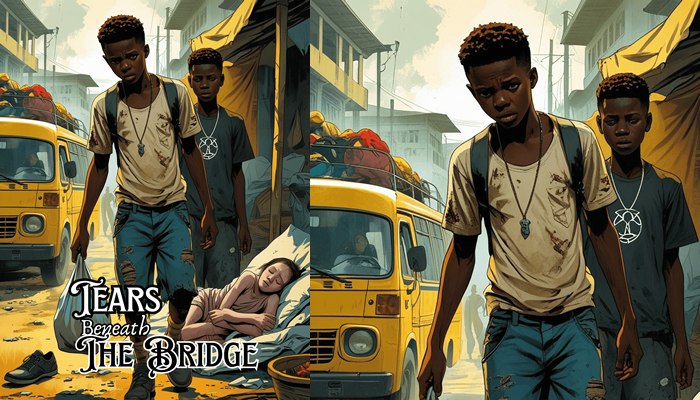
Chapter One: Born on Rough Grounds Somolu no be for the faint-hearted. The air smelled of burnt akara oil, old newspaper ink, wet cement, and something else – something you couldn’t name but knew lived in the corners of Lagos’ underbelly. In the middle of this chaos, inside a narrow face-me-I-face-you compound on Bajulaiye Street, Kola was born at 3:47 am on a rainy Tuesday in June. The kind of rain that slapped zinc roofs with thunderous anger, the kind that flooded dreams and compounds alike. “Mama Tinu don born o!” one of the neighbours shouted, knocking on doors in excitement and relief. She had gone into labour under candlelight, with one elderly midwife, Mama Salewa, shouting “Push! Push!” like she was announcing the second coming of Christ. The baby came out screaming, fist clenched like he knew the battle had just begun. Mama Tinu looked at her boy and whispered, “You go fight for this life, Kola. But you go survive. You must.” There were four other children to come after that, but Kola was the first. And from the very beginning, it seemed like life had a personal vendetta against him. Their home was a single room – ten by ten feet – barely enough to fit the six of them when everyone eventually arrived. A small mattress lay on the floor, pushed against the wall. The only furniture was a stool, one battered wardrobe with a broken hinge, and a table fan that hadn’t worked since NEPA last showed mercy during Yar’Adua’s time. His father, Baba Kola, used to work at a printing press in Mushin. Back when his hands were still steady and his breath didn’t stink of burukutu. But the day the machines crushed his fingers, the press let him go like expired ink. No compensation. No pension. Just, “Go house. Make your wife dey cook better pepper soup for you.” That’s when the drinking began. At first, it was one or two sachets of Chelsea dry gin every evening. Then it turned to seven. By the time Kola was ten, Baba Kola had become a fixture at the beer parlour near Fola Agoro. And every night, he came home with spirits in his belly and thunder in his fists. “Mummy, e don come again o!” Titi, the youngest, would scream as their father staggered into the room. “Wetin una cook? Abi I no dey live for this house again?” he would roar, the stench of alcohol entering the room before he did. Kola learnt early not to cry. Boys no dey cry for Somolu. Tears were expensive, and in this city, they never solved anything. He’d hold his siblings in a corner, whispering Igbo gospel songs his mother used to sing while they waited out the storm that was their father. Sometimes he would fight back. At thirteen, he blocked a slap meant for Titi and earned a scar just below his left eye. “You wan dey form man abi?” Baba Kola barked, belt in hand. “You go soon reach street, make dem teach you wetin be real life.” And the streets did teach him. Kola’s first hustle came at age twelve. He started as a pure water hawker, carrying his basin from Bajulaiye to Bariga. “Ice water, cold pure wata!” he’d chant, his voice hoarse by afternoon. He learned how to dodge LASTMA, avoid street boys demanding ‘tax,’ and run from Alaye extortionists who didn’t care if you were feeding your family or your habit. By fourteen, he graduated to newspaper hawking. He’d collect the day’s papers from the distributor under the Somolu bridge and hustle for spots near traffic at Onipanu. “Oga, buy Vanguard now! Buhari don talk again!” “Punch dey hot today, buy am before e finish!” People ignored him mostly. Or treated him like the dust Lagos never ran out of. But he didn’t mind. Every N50 note added up. He’d rush home before dusk, hand over his daily earnings to Mama Tinu, who always whispered, “Oluwa a fi e wehin rere,” and kissed his dusty forehead. His siblings looked up to him – especially Mide, who was always coughing and whose legs looked like they could break with one wrong step. There was no money for a proper hospital, so they fed him bitter leaf and prayers. School became a luxury. By JSS3, Kola had dropped out. The principal had called Mama Tinu to his office. “Madam, your son is brilliant. But if he can’t pay PTA dues or wear proper sandals, I can’t let him continue. It’s not a charity.” And that was it. That night, Kola cried quietly into his pillow – the same one he shared with Dayo. “God, make I no waste. Abeg,” he whispered. Then came the first death. His uncle, Uncle Razaq – the only man who used to sneak them small foodstuffs from Mushin – got hit by a danfo while crossing at Palmgrove. Just like that, gone. And with him, the last link to any form of help. Mama Tinu wept for days, singing old Yoruba dirges into the night. Baba Kola didn’t say a word. Just drank more. Kola began working at a printing press in Somolu. Same kind his father had lost his fingers to. He’d fold newspapers, align pages, sometimes carry loads for the oga who always shouted, “No go spoil my machine o, I no go pay for dead body!” He worked twelve-hour shifts. No health insurance. No food allowance. Just ₦1,500 daily. But he held on, because in this part of the world, holding on was the only thing anyone could afford. One Sunday morning, something happened. He was walking home from night shift, clothes soaked in ink, when he saw a boy his age snatch a woman’s handbag near Fadeyi. The woman screamed. Kola watched as the thief bolted into a danfo and disappeared. Two policemen nearby came rushing and grabbed the nearest boy standing beside Gala hawkers. “Na him?” one asked the woman.

Tears Beneath the Bridge Read More »

The Silence That Screamed

the silence that screamed

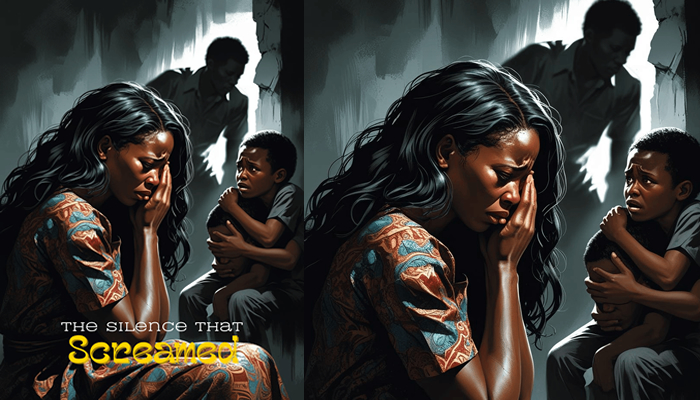
Written by Olorunloba Adeniyi Chapter One – It Is Life That Is Teaching Me) If I ever write a letter to my younger self, I’ll start with this:Toun, don’t ignore your instincts. That ache in your chest when something feels off? That’s not weakness. That’s wisdom whispering. But back then, I didn’t know. I mistook red flags for passion. I mistook fear for excitement. And I mistook Tolu’s attention for love. I met Tolu in 2012, at a mutual friend’s naming ceremony in Akoka. He was tall, dark, and dressed in a crisp white native with minimal embroidery. Nothing flashy – just the right amount of confidence to catch my eye. He smiled at me across the compound while I struggled with my gele in the bathroom mirror. A few minutes later, he sent a small boy with a note scribbled on a napkin. “My name is Tolu. You look too beautiful to be standing alone. Please don’t disappear before I find the courage to walk up to you.” I laughed. That was how it started. Innocently. Sweetly. He called me the next day. Then every day after. In those early months, his attention felt like sunlight – warm and constant. He would pick me up from my teaching job at St. Mary’s and take me to the suya spot near Bariga just to watch me eat. “You eat like you’re always hungry,” he’d tease. “Because I am,” I’d respond with a mouthful, laughing. Tolu made me laugh then. And I, a pastor’s daughter, was smitten by the idea that this seemingly worldly man found me interesting. By the sixth month, he asked to meet my parents. “Ẹ̀gbọ́n mi, he’s very serious o,” Sade, my sister, told me. “A man that meets your father is ready to settle.” And in our family, once a man meets Pastor Adegboyega, marriage was all but sealed. My father asked him the usual questions – “Do you have a job?” “Where do you worship?” “What are your intentions for my daughter?” – and Tolu answered them with the smooth confidence of a man who had rehearsed. I should have paid more attention to how he never met my eyes when he spoke. We married the following year. A proper Yoruba wedding – blessing by both families, church ceremony, and an owambe reception in Ibadan that lasted till dusk. My gown shimmered with gold stones. Tolu wore a matching agbada with a maroon fila. Everyone said we looked like royalty. “Omo pastor ti r’oko!” my mum danced, throwing white powder over me. “Toun baby, you have arrived o!” I smiled. But even as the music blared and friends sprayed naira notes over us, a tiny part of me wondered why I felt so hollow. Our first year together was good. Really good, in fact. We moved into a two-bedroom flat in Surulere. I decorated it with throw pillows and artificial roses. I got pregnant quickly, and Tolu was over the moon. He would rub my belly every night, murmuring, “Oluwafunmi, Daddy loves you already.” He pampered me. Brought food home. Called me from work. Sometimes, he’d sit beside me and press his lips to my belly and say, “Toun mi, I’ll protect you and our daughter with my life.” And I believed him. But something shifted after Funmi was born. It started subtly – little comments that felt like jokes at first. “This your stomach no go go down?”“You’ve changed o. Is this how all women lose their fine shape after marriage?” Then came the silent treatments. The long stretches of silence when I didn’t know what I’d done wrong. One time, I served him slightly burnt rice. He didn’t touch the food. Just stood up, went to the kitchen, poured the entire pot into the dustbin, and returned to sit quietly with the TV on. When I asked, “Tolu, kilode?” he didn’t reply. He didn’t talk to me for three days. The first slap came in our second year. I had returned home late from my mother’s place in Ibadan, where I’d taken Funmi for the weekend. Tolu had called to say he had an emergency trip to Abuja. He said not to bother coming back till Sunday night. But when I got home that evening, I found him in the sitting room, drinking Origin, the bottle half-empty. “So you think you can come and go as you please, abi?”“Ah, Tolu, you said you were going to Abuja now -”“And so? I changed my mind. Must I report to you?” I tried to explain, to calm him, but he shoved me first. Then slapped me across the face. The sound echoed in the room, and for a brief second, it felt like the air had been sucked out of my lungs. I didn’t cry. I didn’t scream. I just stared at him. And he stared back – cold. Distant. “Let this be the last time you act like a whore in my house.” That night, I slept in Funmi’s room, cradling her to my chest as I whispered Mo sorry, ọmọ mi. I’m sorry. The next morning, he bought me meat pie from Sweet Sensation and said, “I was drunk. I didn’t mean it.”I accepted the food. And the lie. It became a cycle. Each time he hit me, the next day came with a gift – shawarma, a new dress, airtime credit. He’d say, “Toun, I just get angry sometimes. You know I love you, abi?” And I’d nod. Because what would I say? That my “good husband” was turning into a monster? That my family’s pride – “omo pastor ti r’oko” – was cracking? I stayed. For Funmi. For the image. For fear. I stayed. By the time I had Dare, the slaps had evolved into beatings. He once used a belt. Another time, a stool. When I tried to run, he locked the door and beat me until I bled from my nose. And still, I stayed. I told no

The Silence That Screamed Read More »

Scroll to Top