
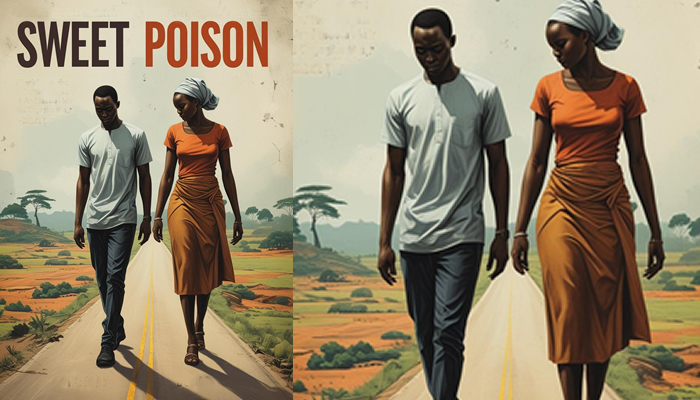
Chapter 1 – The Girl at the Food Stall
Niyi wasn’t sure if it was the sun or the hunger that was making him dizzy.
Lomé was different from Lagos – slower, softer, but just as unpredictable. He had been in the city for only five days, but it already felt like he was walking through a dream he couldn’t fully understand. The red-clay dust coated the soles of his sneakers. The air smelled of spice, salt, and diesel. The people smiled with a politeness that didn’t always reach their eyes.
He was standing at a roadside stall just off Rue de la Kozah, eyeing a tray of akara balls. The woman selling them was already wiping her hands on her wrapper, expecting him to pay. But Niyi hesitated, frowning like the akara had personally offended him.
That was when he heard her voice behind him.
“Why are you looking at the akara like it insulted you?”
He turned.
She stood with one hand on her hip, her lips curved in a half-smile. Brown skin glowing under the noon sun, braids neatly tucked beneath a colorful scarf, and a calm in her eyes that didn’t match the chaos of the street.
“I’m just deciding if I want to commit to it for life,” Niyi said, grinning.
She raised an eyebrow. “Commitment issues. I see.”
He laughed. Loudly. Too loudly. A few heads turned. She didn’t seem to mind.
“Let me guess,” she added, walking closer. “You’re not from around here. Nigerian, maybe? Yoruba?”
“Guilty.”
“You people and your sharp mouths.” She turned to the akara seller and said something in Ewe, fast and lyrical. The woman chuckled and handed her a small paper wrap of akara, then passed one to Niyi too.
“I didn’t pay yet,” he said.
“First time is on me,” she replied, popping a piece into her mouth. “Next time, you can buy for both of us.”
Niyi blinked. “You assume there’ll be a next time.”
“There always is. When the akara is this good.”
She walked off, just like that, daring him to follow her. He did.
They strolled side by side through the dusty streets, nibbling on hot akara and tossing jokes like old friends. She told him her name was Adjoa – half Nigerian, half Togolese. Her mother was from Ibadan, her father from Kpalimé. She grew up speaking Yoruba, Ewe, and French, but preferred English for the way it let her play with sarcasm.
“And you?” she asked, brushing crumbs from her lips. “Why are you in Togo? Business? Pleasure? Or just running from something?”
He smirked. “Maybe I’m running to something.”
“Or someone?”
He gave her a look. “Too early to tell.”
She didn’t blush. Instead, she slowed her pace and looked at him with that same calm, almost unreadable expression. “People come to Lomé looking for peace. Or escape. But sometimes, the city gives you what you didn’t know you were looking for.”
Niyi chewed in silence.
The truth was, he didn’t know why he was in Lomé. Not really. He told people it was for work – a small logistics deal he was trying to broker between two West African firms. But that wasn’t the full story. He was tired of Lagos. Tired of endless traffic, recycled relationships, unspoken pressure. Lomé felt like a pause. A fresh start.
And then Adjoa had appeared like a glitch in the script.
They walked until the sun softened. She took him past narrow alleys, small shops with handwritten signs, children kicking deflated footballs. Eventually, they sat under a mango tree near her compound. She pointed to the bench like it was a throne and said, “Sit. You’re now officially my guest.”
He sat. She followed.
They talked until the call to prayer floated across the rooftops. About nothing. About everything. Niyi noticed how she listened – not just with her ears, but her eyes. She had a way of leaning in when he spoke, like she was measuring the weight of his words.
“I like you,” she said finally, standing.
“That’s sudden.”
“I’m sudden.” She gave him a wink. “And I don’t have time for Lagos boys who talk too much but never call.”
He chuckled. “So call me first.”
“Ah, Yoruba men. Always turning tables.”
But she pulled out a pen from her bag and wrote her number on his palm anyway.
“Don’t wash it off till tomorrow,” she said.
And just like that, she disappeared through a rusty gate, leaving him sitting under the mango tree, heart ticking faster than it should.
Chapter 2 – Three Weeks of Heaven (Revised & Expanded)
Niyi had been in Lomé for fifteen days. By the twenty-first, he no longer felt like a visitor.
The change was slow but sure – a shift in how people looked at him on the street, in the way the security man at the compound began calling him mon beau-frère playfully, and how the kids shouted “Nii! Nii! Apoutchou!” each time he returned from the market.
Lomé had a pulse that was different from Lagos. Softer. Quieter. The streets breathed with a rhythm you couldn’t rush. People greeted with care, lingered in conversations, and gave you space to be unknown without suspicion. Yet, within that gentleness was an unspoken code — you respect the land, or it will swallow you slowly.
And Adjoa… Adjoa made the land feel like home.
Every day began with her voice – sometimes in a voice note, sometimes with her knocking on his window.
“Debout, monsieur! Your tea is getting cold.”
“Hurry, let’s go and fight tomatoes at the market.”
“Bring your French. Today, you’re negotiating with madame Gbéto – she doesn’t smile.”
She took him everywhere. From the bustling Marché Assigamé to the backstreets of Nyékonakpoé, where vendors sold roasted corn, fried fish, and piles of second-hand clothes that smelled like Europe’s forgotten laundry.
They strolled past loudspeakers blaring coupé-décalé and Fuji music. On one corner, a vendor fried gboma dessi while shouting in a mix of French and Mina. On another, an old man waved carved wooden charms and muttered prayers into a bottle of schnapps.
“That’s Bokonon,” Adjoa whispered, pulling Niyi closer. “Local spiritualist. People say he once turned a goat into a man.”
“Then he should turn my bank account into a trust fund,” Niyi muttered.
She laughed. “You and your Lagos mouth.”
At her compound in Tokoin, Niyi became a regular fixture. He often sat on a small stool outside with Adjoa’s cousin, Komi, who was half-blind and addicted to Nescafé. Komi liked to say he once dated a Miss Togo runner-up but lost her to a man who had a Peugeot 505.
“Life is balance,” he said, slurping his coffee. “You win akara, you lose woman.”
Then there was Auntie Marie, a widow with a strong arm and a sharper tongue. She sold attieke and grilled tilapia across the road and liked to gossip at dawn.
“That your boyfriend,” she said to Adjoa one morning, “he walk like Lagos big man but carry bucket like village boy. He will make a good husband.”
Adjoa just smirked.
“We’re not there yet, Auntie.”
“You better be. Pretty girls don’t stay pretty forever. Even ripe mango rot if you don’t pluck it.”
Their love deepened over small moments: hushed conversations under mango trees, shared meals of ablo and peanut soup, and occasional fights over whose French was worse.
“You said j’ai deux riz instead of du riz! You told the waitress you have two rice!”
“Well, I do! I have jollof rice in my soul and fried rice in my heart.”
“Mon Dieu.”
They visited the coast at Aného, where Adjoa walked barefoot on the sand and dared Niyi to sing a Yoruba song to the ocean. He did – off-key and dramatic – earning laughter from some nearby fishermen who clapped and offered him coconut water in solidarity.
“Yoruba man, your voice dey pain my chest,” one shouted in Pidgin.
“But your love strong!” another added.
But it wasn’t all laughter.
One evening, as Niyi helped her carry groceries, a small boy ran up.
“Adjoa! Maman t’appelle. Vite!”
Her face changed.
Niyi followed her through the narrow corridor into their compound. Her mother was on a mat in the sitting room, propped up with cushions, wheezing softly. The air smelled of camphor and dried hibiscus.
Her cheeks had hollowed. Her breath was shallow and slow. The woman who once teased Niyi for being too skinny now looked like she could be carried by the wind.
Adjoa kneeled quickly, rubbing her mother’s back. “Ça va, Maman? You need water?”
She didn’t respond.
Niyi watched, heart pounding. “Is she okay?”
Adjoa shook her head. “She’s been like this all day. It comes and goes.”
“What’s the diagnosis?”
“The doctors just say ‘chest infection.’ They want money before they test more.”
That night, Niyi couldn’t eat.
He stared at his plate of fried yam and stared longer at his bank app. He thought about his father’s land in Ibadan – a quiet plot with thick soil, passed down like a secret.
The next morning, he called his cousin back in Nigeria.
“Sell it,” he said.
“You sure?”
“Yes. It’s urgent.”
What followed was a string of desperate errands.
He visited clinics with names like Centre Médical Espoir and Clinique Bon Coeur, arguing with receptionists who switched to French when the bills came.
“Monsieur, ce n’est pas une ONG ici. Il faut payer d’avance.”
“I’m not asking for free treatment, I just need time!”
“Désolé. Sans paiement, pas d’examen.”
One pharmacist offered him expired medication at a discount. Another said he could “borrow drugs” – but if the full price wasn’t paid in 48 hours, the police would be involved.
“This place is mad,” Niyi muttered.
“This is Africa,” Adjoa replied, exhausted. “We cure sickness with begging and favors.”
Still, Niyi pushed through. He found a sympathetic nurse, a cousin who smuggled antibiotics from Ghana, a church that gave small donations. At night, he lay beside Adjoa on a bamboo mat outside the clinic, her head on his chest.
“You’re doing too much,” she whispered.
“You’re not doing enough,” he said softly.
She didn’t answer.
But her hand found his under the moonlight. And she held it like it was the only thing keeping her grounded.
Chapter 3 – The Price of Love
Niyi always thought sacrifice would feel noble. Like the kind of thing that filled you with purpose – like a gospel song rising from the chest. Instead, it felt like sweat-soaked shirts, stiff backs from concrete clinic benches, and a constant tremble in his left eye.
He sold the land.
It didn’t even take long.
His cousin in Ibadan found a buyer within days – one of those loud church elders who always said “God will provide” but was quick to snap up property when the desperate came calling.
“You sure you no go regret am?” his cousin asked.
“Just collect the money,” Niyi replied, eyes bloodshot. “And send it fast.”
He received the alert three days later: ₦3.2 million. Everything gone in a single transfer. Years of inheritance. A dream he once had of building a quiet home near the Eleyele dam with a small garden and a red-painted gate.
Now it was medicine money.
In Lomé, his days were a blur of heat and exhaustion.
He rented a battered motorbike and zipped across the city – from one pharmacy to another, chasing prescriptions, discounts, and hope. Most times, he carried a brown envelope full of worn documents, X-rays, and receipts.
The nurses at Clinique Sainte-Marie knew him by name.
“Monsieur Niyi, encore ici?”
“Oui. Encore moi.”
“Toujours pour la dame âgée?”
“Oui, pour la maman d’Adjoa…”
They smiled with sympathy. But the bills kept growing.
One afternoon, after he spent almost CFA 160,000 on new antibiotics, Niyi sat in the clinic yard and cried. Quietly. Fist against his mouth. A man does not weep in public in Nigeria – but this was not Nigeria. This was a city where love had made him too vulnerable to care about image.
Back at the compound, Adjoa watched him with a mix of gratitude and unease.
“I wish you didn’t have to do all this,” she said, once.
“If I don’t, who will?”
“But it’s not your responsibility.”
“You’re my responsibility.”
She fell silent.
It was the kind of silence that didn’t come from shyness – it came from distance. From something she wasn’t saying.
But Niyi didn’t ask. He didn’t want to ruin the illusion. Not yet.
At night, the city’s peace turned hostile. There was an unspoken curfew under the military-backed government. Gendarmes in navy-blue berets patrolled the streets in rickety trucks, their rifles glinting under streetlamps.
One evening, Niyi left the clinic past 10 p.m. The streets were almost empty. He rode fast, helmet tilted, eyes on the road. But just before the turn into Tokoin, he saw flashing torches and heard the familiar bark of authority.
“Hé! Toi là! Descends!”
He slowed. Too late.
A gendarme yanked him off the bike.
“Tu sais pas qu’il y a le couvre-feu? Hein?!”
“Je… je viens de la clinique! I’m just coming from hospital!”
“Papiers. Maintenant!”
His voice trembled. He opened the brown envelope – hospital receipts, prescriptions, an empty pill packet.
Another officer stepped closer, rifle swinging.
“You no sabi say 10pm na danger hour? You dey carry drug dey waka? You be who? Smuggler? Spy?”
“No, officer, please -”
“Shut up. Turn around. Hands on the bike.”
They frisked him, rough hands digging into his pockets. One slapped his head.
“You don’t even look like you from here.” one muttered in Pidgin
A younger officer squinted at the documents.
“C’est vrai, capitaine… Il vient vraiment de la clinique. Pour une vieille dame malade.”
After a pause, the captain waved him off.
“Next time, no excuse. You go sleep cell.”
Niyi nodded. Hands shaking. Knees weak.
He rode home in silence.
When he got to Adjoa’s compound, the gate was locked. He knocked once, twice – then again. Finally, a sleepy Komi opened it.
“Ah, mon Lagos, why you dey come like thief?”
“Long story.”
He didn’t tell Adjoa what happened that night. He only said, “I almost got arrested,” and she replied with a soft “I’m sorry.”
But something had shifted.
She no longer sat as close under the mango tree. No longer sent playful voice notes. Her replies grew shorter. Her voice less musical. Sometimes, she disappeared for hours – always saying she went to see her aunt in Akodesséwa.
“You don’t need to worry so much,” she said one evening. “My mother is improving now. Maybe you should rest a bit.”
“Are you saying I’m doing too much?”
“I’m saying… you don’t have to destroy yourself to prove something.”
“Is that what you think I’m doing?”
She didn’t answer.
Instead, she turned and walked into the house.
That night, Niyi couldn’t sleep.
He lay on his thin mattress, fan humming above, body aching. In the darkness, he stared at the ceiling and whispered to himself:
“I sold my future for this.”
And in his chest, something – very quietly – began to rot.
Chapter 4 – The Silence Between Them
Niyi noticed the silence before he noticed the man.
It began with skipped greetings. The morning voice notes stopped. The warm glances across the mango tree bench became polite nods. Adjoa started responding to his jokes with tired smiles – the kind that didn’t touch her eyes.
He told himself it was fatigue.
Her mother was still recovering. The pressure. The stress. But deep down, something in his gut stirred.
It stirred louder when Elom entered the picture.
Elom was the kind of man who didn’t need to announce himself.
He had the quiet confidence of someone born and raised in the same compound for decades. A tall, caramel-skinned Togolese with a sculpted jawline, impeccable French, and the kind of smile that looked both holy and seductive.
He drove a battered Peugeot 406 and wore fitted Ankara shirts that made Niyi feel underdressed.
“C’est mon cousin,” Adjoa said the first time, too quickly.
“From your mother’s side or father’s?” Niyi asked.
“Extended family,” she replied, avoiding his gaze.
Elom greeted Niyi with a soft handshake and that heavy French-accented English. “Ah, the Nigerian. Welcome. You are… staying long?”
“Not sure,” Niyi said, forcing a smile. “Maybe.”
“That’s good. Lomé is soft. People who rush too much don’t last here.”
That first meeting ended with the three of them sharing boiled plantain and pepper sauce in the compound. Elom and Adjoa laughed in Ewe – fast, familiar, musical – and Niyi sat quietly, chewing slower, not understanding a word.
He wasn’t jealous. Not yet. But he noticed how her eyes lingered longer when Elom spoke. How she touched his arm when she teased him. How she laughed differently – more freely.
The neighbors noticed too.
One morning, Auntie Marie whispered across her stall:
“That Elom boy dey show face again. And your girl no dey chase am.”
“He’s her cousin,” Niyi replied, coldly.
“My late husband’s cousin chop me pass goat meat. Be careful, o. Cousin is just another name for sweet temptation.”
Later that week, Niyi arrived at the compound with medication – a refill for Adjoa’s mother’s blood pressure – only to find the gate ajar and laughter spilling from the backyard.
He turned the corner and froze.
Adjoa was seated beside Elom on a wooden bench. Her head was tilted toward his shoulder as she laughed, eyes glinting. Elom was speaking in soft French, low and intimate. Their knees touched.
She didn’t see Niyi at first.
When she did, her smile faltered. Just slightly.
“Niyi… you came early.”
“Yeah. Just wanted to drop these.”
He didn’t sit. He didn’t greet Elom.
He handed her the plastic bag and turned to leave.
“Niyi, wait -”
But he was already gone.
That evening, she came to his apartment.
She didn’t knock. She just stood at the doorway, framed by the orange-pink glow of the setting sun.
“You’re angry.”
“Should I be?”
“It’s not what you think.”
“Then tell me what to think.”
She stepped inside. The room smelled of garri and stale fan air. She sat on the edge of the bed.
“Elom and I grew up together. Our families have always been close.”
“So close that you forget I exist when he shows up?”
“Don’t do that.”
“What exactly are we, Adjoa?”
The question hung there – sharp and naked.
She looked away. Her fingers twisted the edge of her wrapper.
“You’ve done a lot for me,” she said finally. “More than I can repay. But… things are complicated.”
“Then make them uncomplicated.”
“You don’t understand my culture. My family. What they expect.”
“I gave up everything for you.”
Silence.
“Say something,” Niyi said, voice breaking.
“Maybe you shouldn’t have.”
That night, he didn’t sleep.
He heard her voice in his head, over and over. Maybe you shouldn’t have. He thought of Elom’s hands. The way she laughed. The way she didn’t stop it.
The streets outside were quiet, save for the occasional tokunbo motorbike sputtering past. Somewhere in the distance, a baby cried. Somewhere closer, a woman sang a lullaby in Ewe – low, tender, ghostly.
Niyi sat on the floor and hugged his knees.
His phone buzzed. A WhatsApp message from Emeka in Lagos.
EMEKA: Bro how far with that Togolese babe now? You go carry her come Naija or what?
NIYI: I no even know again.
He didn’t open Instagram that night. He was afraid of seeing Adjoa’s smile in a picture he wasn’t part of.
The next morning, Adjoa didn’t send a voice note.
Niyi didn’t call.
For the first time in weeks, he stayed inside all day – watching geckos race across his ceiling, counting the cracks in the wall, wondering when exactly the magic had begun to spoil.
Chapter 5 – Whispers in the Compound
In Lomé, heartbreak didn’t come with thunder. It came like dust – soft, creeping, invisible until it settled on everything.
Niyi spent most of his days in a daze now. The compound that once buzzed with light and affection now felt heavy. Even the mango tree outside Adjoa’s window – the one where they first sat and shared secrets – had lost its shade.
Adjoa had become a silhouette of herself. Not angry. Not cruel. Just… gone. A ghost that still moved through the compound, but never toward him.
One afternoon, Niyi sat beside Komi, the one-eyed cousin who always drank Nescafé like medicine. They were shelling roasted groundnuts in silence when Komi leaned closer.
“You still dey follow Adjoa like say she never leave?”
Niyi frowned. “What do you mean?”
Komi squinted through his good eye. “You never hear?”
“Hear what?”
The old man sighed and sipped his lukewarm coffee.
“Na you I pity, not her. The whole compound don dey talk.”
“Talk about what?”
Komi looked over his shoulder, then leaned in.
“They say her uncle arranged one marriage. Big man from Accra. He dey come next week. Wedding go happen sharp sharp.”
Niyi didn’t speak.
His throat closed up. The air around him blurred.
“It’s Elom, isn’t it?” he asked, though the words tasted like rust.
“Nobody sure. Some say na politician friend. Others say na Adjoa herself pick the man.”
“She never said anything…”
Komi grunted. “You think she fit? After all your sacrifice? Abeg. No vex, Nii. But sometimes, love no dey fear betrayal.”
That evening, Niyi walked the length of the compound three times. He didn’t see her. Her door was shut. No lights. No laughter.
He sat under the mango tree alone.
Auntie Marie walked past with a basin of smoked fish on her head.
“Mon fils,” she said gently. “Your face is too long these days.”
“Is it true?” he asked. “About the marriage?”
She paused.
Then nodded.
“They say the man from Ghana is rich. Respected. Speaks French like the President himself. Her uncle likes him. So do the elders.”
“But does she like him?”
“Does that matter?” she replied. “Sometimes, in our culture, liking is a luxury.”
The next day, Niyi found out from someone even crueler: a child.
He was standing outside a boutique in Kodjoviakope, buying airtime, when Adjoa’s little cousin, Afia, ran up to him.
She was maybe eight years old, gap-toothed and always chewing on sugarcane.
“Uncle Niyi!” she shouted. “You’ll come for the wedding, abi?”
He blinked. “Wedding?”
“Aunty Adjoa’s wedding! They’re printing cards. My mummy said I’ll wear lace!”
She beamed, dancing in her blue sandals.
He didn’t hear the rest. The world faded out.
When he returned to the compound, he found her sitting alone, back against the tree they once called “their spot.”
She didn’t smile.
Neither did he.
“You’re getting married.”
She closed her eyes. “It’s complicated.”
“To who?”
“Someone my uncle trusts. He’s… safe.”
“But I was safe. I gave up everything.”
She looked up. Her eyes were tired, but dry.
“You gave too much.”
“I was trying to build a future.”
“And I was trying to survive the present.”
Silence.
“You didn’t even tell me.”
“Would it have made a difference?”
“I could’ve fought -”
“Fought who? My uncle? My culture? My poverty?”
She stood up.
“You were my escape, Niyi. Not my destination.”
He stepped back like she’d slapped him.
“So that’s all I was to you?”
“You were good to me. Maybe too good. But in this part of the world, love is a bird with clipped wings. It sings, but it doesn’t fly.”
She walked away.
Niyi didn’t call after her.
He just stood there – heart wide open, and nothing inside.
That night, the mango tree dropped a ripe fruit beside his feet. He didn’t touch it.
Chapter 6 – The Poison in the Stew
Niyi didn’t remember eating that day.
His memory had been unreliable since the confrontation – since Adjoa looked him in the eye and told him, You were my escape, not my destination.
But he did remember the hunger.
It was a hunger born not just in the stomach but in the chest – the aching kind that comes from carrying too much grief in too little time.
He had planned to leave Lomé quietly. No farewell, no scenes. Just him, his backpack, and whatever was left of his dignity. Sokodé would be his stopover before heading to Kara, then eventually slipping back into Nigeria like a wounded animal crawling into familiar bush.
Komi stopped him at the gate.
“You dey go like that?”
“There’s nothing left for me here,” Niyi replied.
“Wait, eat something first. You no fit dey travel with empty belle.”
Niyi hesitated.
Komi smiled. “Na only yam and sauce. No sentiment inside.”
The yam was fried golden, the stew dark and rich with oil and dried pepper. It smelled like home.
He ate quickly, mechanically, trying not to feel anything. Komi sat across from him, sipping Nescafé, watching with his good eye.
“She for follow you, you know. If this life no hold her neck like belt.”
“She made her choice.”
Komi grunted. “Sometimes, choice na luxury too.”
By evening, Niyi was gone.
The bus station in Sokodé was chaos wrapped in dust. Horns blared. Vendors screamed. A goat bleated as it resisted being dragged into a bus trunk. The air was thick with diesel and old sweat.
Niyi sat on a broken bench under a rusted awning, waiting for the night bus to Kara.
That was when his stomach turned.
At first, it was just nausea – the kind that comes after too much pepper. But then his vision doubled. His mouth went dry. His throat burned.
His limbs felt heavy.
Then everything dropped.
He collapsed sideways off the bench, his head hitting the earth with a soft thud. People stepped around him. Someone laughed. A driver cursed in French.
“Regarde ce fou-là. Trop de gin encore.”
“Tchrrr… il veut dormir ici?”
No one helped.
Not the man selling orange Fanta. Not the woman breastfeeding under the blue umbrella. Not the two policemen leaning on their bikes, lazily scanning the crowd.
Niyi’s body trembled.
His mouth foamed slightly at the edge. His pulse slowed.
“Adjoa,” he whispered, lips barely moving. “Adjoa…”
But there was no Adjoa.
Just flies buzzing around his nose. Just boots walking past. Just the sound of buses revving toward destinations that no longer mattered.
He drifted in and out of something that wasn’t quite sleep and wasn’t quite death.
In one moment, he dreamed of Lagos – smoky suya stalls, his mother laughing in the kitchen, his father polishing his shoes on Sunday.
In another, he saw Adjoa in white lace, holding Elom’s hand, her eyes searching the crowd for someone she once knew.
Two days passed.
He wasn’t sure how he survived.
Maybe someone finally poured water on his face. Maybe a kind stranger fed him sachet milk. Maybe God just hadn’t signed his death certificate yet.
But when he opened his eyes, he was still lying in the same motor park. Still surrounded by indifference. Still alone.
He tried to sit up. His limbs refused. His mouth opened, cracked and dry.
“Adjoa…”
Nothing answered.
Not even an echo.
Later that night, a tired driver – an old Hausa man named Mallam Dogo — finally helped him into the back of a pickup truck.
“You get people for Lagos?”
“Yes.”
“You go reach them. No die here.”
He gave him half a bottle of malt and three cubes of sugar.
Niyi sipped slowly, every swallow burning like fire.
As they drove away from Sokodé, the streetlights of Lomé faded into shadows behind him.
And in the darkness, one thought kept bleeding through his mind:
She didn’t just leave me. She erased me.
Chapter 7 – The Boy Who Came Back Hollow
Mushin hadn’t changed.
The air still smelled like fried oil and exhaust. The gutters still overflowed after every rain. The danfo drivers still insulted each other with Shakespearean flair.
But Niyi had changed.
When he stepped off the interstate bus, he didn’t walk – he dragged himself. He looked like a man who had seen the inside of a grave and crawled back out. His eyes were dull. His skin pale from hunger and sun. His spirit? That was harder to describe.
Emeka was the first to see him.
“Guy! Jesus. You look like one of those war documentaries.”
Niyi forced a smile that didn’t quite form.
“You know say documentary na still film. This one na real life.”
They hugged awkwardly. Emeka tried to joke, to prod, to get the old Niyi back.
But he wasn’t in there.
Not yet.
Back in his room – a small square space with cracked tiles and faded curtains — Niyi sat on the bed for hours. The walls felt closer now, as though the room was trying to hold him up, or bury him deeper.
He hadn’t told anyone the full story.
He didn’t say “I sold land for her.”
He didn’t say “She picked someone else.”
He didn’t say “They poisoned me.”
He just said, “Togo was hard.”
That was enough.
Weeks passed.
People asked questions.
“So what happened between you and that fine Togo babe?”
“She dey alright?”
“When you go visit her again?”
Niyi would shrug. Say something vague.
The truth felt like a rope he no longer wanted to pull on.
At night, he sometimes dreamed.
He’d see her in a yellow dress, sitting under the mango tree. She’d wave. He’d walk toward her. But just as he reached out, the tree would vanish, and she would fade into dust.
Once, he woke up crying.
He didn’t know if it was grief, shame, or just the body leaking what the soul could no longer hold.
His friends moved on. Life moved on.
The Lagos chaos wrapped around him like smoke – choking but familiar. He got small gigs, found new distractions. Ate better. Laughed sometimes.
But he never fully returned.
Something in him stayed buried on the floor of that bus station in Sokodé. Something he gave to a girl who once made akara taste like destiny.
One rainy evening, as thunder grumbled in the sky, Emeka asked casually:
“You ever think she loved you?”
Niyi looked out the window.
“Maybe.”
“Even after everything?”
“Maybe she did… in her own way. But love without loyalty is just sweet poison.”
“Sweet poison?”
“Yeah. It tastes warm going down… but it kills from the inside.”
He didn’t hate her.
He just carried her differently now – not as a person, but as a lesson etched in bone.
Some hearts, he learned, no matter how beautiful, are not meant to be held.
They’re meant to burn.
Disclaimer
This is a work of fiction. Names, characters, places, and incidents are either the product of the author’s imagination or used fictitiously. Any resemblance to actual persons, living or dead, events, or locales is entirely coincidental.
The story contains mature themes related to love, betrayal, and emotional trauma, which are intended for a reflective and adult audience. Reader discretion is advised.